


Doing something for humanity...
It can be done through research and clinical trials.

You can certainly make a commitment to humanity by participating in a scientific study or clinical trial. We always need patients, to achieve adequate results.
You should know that there is a difference between a research study and a clinical trial. I am happy to explain.
A scientific study is usually conducted by universities, researchers, doctors and professors. The research involves questioning people (patients, but also relatives or other people from a particular target group) as a function of their experiences in a particular research, medical course or treatment. The aim of the research is to gain more insight into these people's experiences or possible consequences of the treatment/methodology. From these insights, one can then optimise the pathway, thereby negating any negative experiences. Participation in such studies is therefore important, in order to improve future treatments.
A clinical trial (clinical study) is a study in healthy volunteers or patients of a particular target group that aims to establish or confirm the clinical, pharmacological or other pharmacodynamic effects of one or more drugs and to identify any side effects of these drugs. A clinical trial thus aims to improve medicine. More specifically, they aim to find and test new treatments for certain conditions or diseases even before they are marketed. Furthermore, they will try to further improve existing treatments and aim to gain a better understanding of certain conditions or diseases (causes, impact of nutrition, mechanisms of action, risk groups). Clinical studies are also carried out to detect diseases better and faster. A clinical study is thus a compilation of scientific questions. By seeking answers to those questions, researchers hope to improve medicine. Participants in clinical studies thus help advance healthcare. All clinical trials are strictly regulated by law and ethically approved before they can start.
Before embarking on such research or study, it is best to be well informed by your treating physician. After all, he/she knows best what is possible for you and what is really not.Professor Dr Tessa Kerre Tweet
Clinical studies are invaluable
Science evolves rapidly and innovation never stops ... thankfully. So we regularly find new therapies that can cure and/or treat patients better and faster. Clinical studies are invaluable here! The help of patients is necessary for this.
Everyone takes a painkiller from time to time, everyone knows someone who has been cured again thanks to very effective medicines. But often people do not think about how these drugs were developed. We can take these medicines, thanks to the participation of healthy volunteers and patients from certain target groups in clinical studies in the past. Without them, the drugs could not exist.
And so you too can play an important role! By participating in clinical trials yourself today, you can ensure that people will have access to even better drugs and therapeutic treatments in the future. Developing such a medicine takes up to 14 years on average. So the people of today, take care of their fellow human beings in 2039 !
Clinical trials proceed in four phases, which must be closely monitored
- Phase I: the safety and efficacy of the new medicine are tested on a small number of cancer patients. This phase assesses the general effects (e.g. absorption into the blood), whether the medicine is safe and whether there are any immediate side effects.
- Phase II: The drug will be further tested on a limited group of cancer patients. The aim now is to further monitor the safety of the drug and to verify whether the intended effect is achieved in the short term, i.e. its efficacy.
- Phase III: the medicine is tested on a larger group of patients in order to assess its effectiveness and side effects over a slightly longer period of time. This usually involves a comparative or controlled study. The effectiveness of the medicine is compared to that of current medication. Half of the patients receive the current standard therapy, or if no standard therapy exists, a placebo, an inactive substance. The other half of the patients are treated with the drug under investigation. If the drug passes this test, it is registered by the European Medicines Agency (EMA). The pharmaceutical company will then have to apply for a licence in Belgium from the Federal Agency for Medicines and Health Products (FAGG). If the application receives a positive recommendation, the Minister of Social Affairs will consider whether the drug will be reimbursed by the health insurance fund. This will always be done in consultation with the Minister of Budget.
- Phase IV: this phase takes place once the medicine is already on the market. The product is monitored further, partly to detect extremely rare side effects and to study the long-term results. But also, for example, to test whether it can combat other diseases or be prescribed to children. After all, testing medicines on children in phases I to III is not permitted.
Interested?
Further information about clinical studies can be found in this BHS brochure.
Click on the photo on the right...


Do you really want to participate?
After reading all this information, are you interested in part at take to a study or a clinical trial, If you are interested, you can register as a patient to participate via various websites listed below.
In this way, you will make a concrete contribution to the development of better, safer medicines and therapies, with long-term prospects.
The studies are thoroughly evaluated and approved by a ethics committee.
Patients must always comply with strict criteria so that your own safety is never compromised. The attending physician is aware of the latest therapies and clinical studies. So always make sure you are well informed. by him, so that you can make a well-considered decision together.

NEW … ADDITIONAL SURVEY QUESTION!! (31/08/2026)
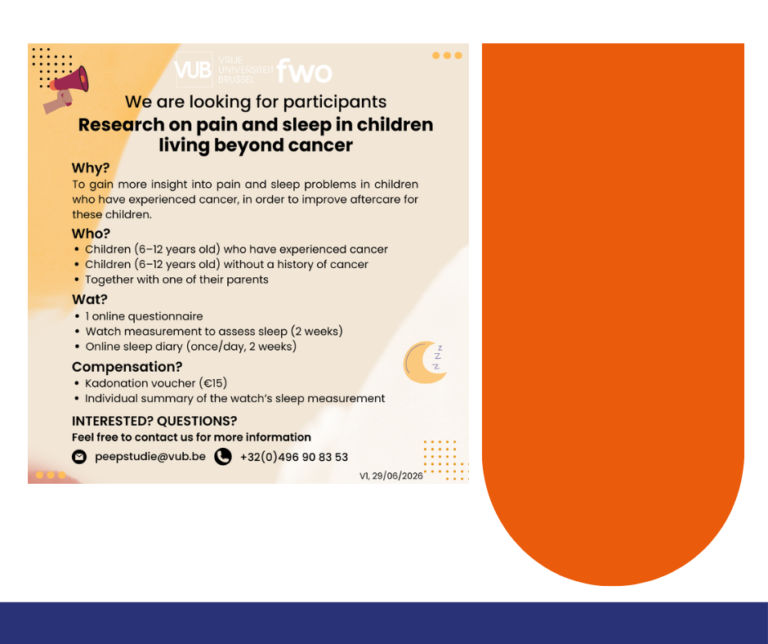
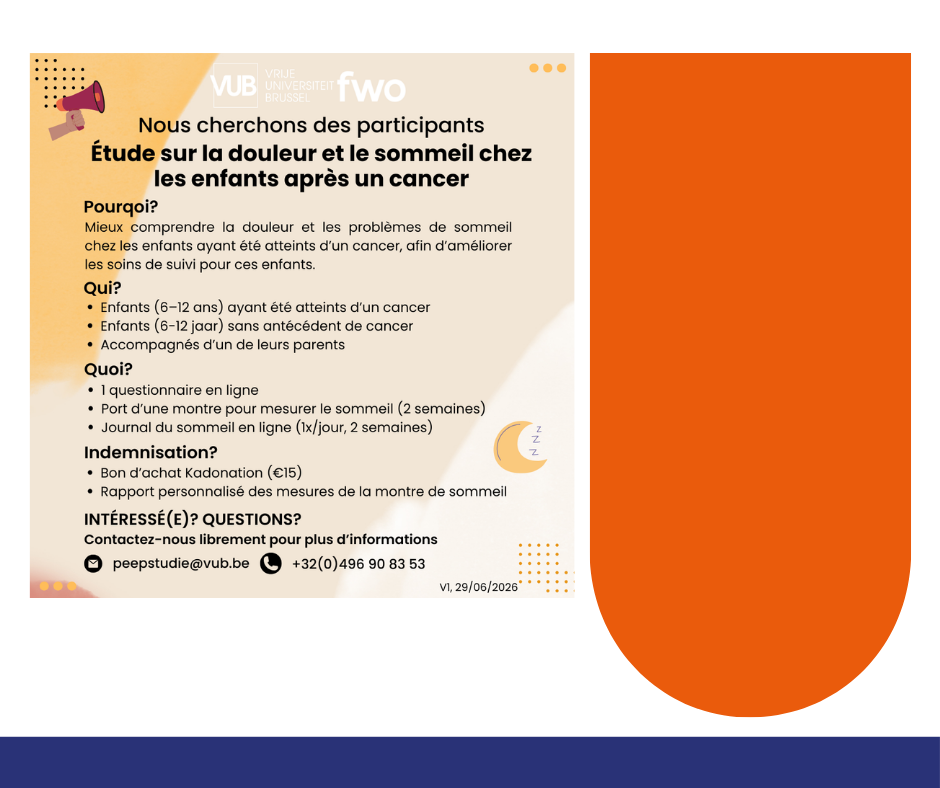
The research isn’t quite finished yet! The researchers are currently Urgently seeking the last 18 children with a history of cancer to complete the planned sample. That is why they would like to ask for your help once again.
VUB research Around pain and sleep problems in children after cancer.
Who are we looking for: 38 children (6-12 years) with a history of cancer (max 5 years after end of treatment) and 38 "healthy controls" (children with no history of cancer), together with one of their parents.
Purpose of the study: identify the prevalence of pain and sleep problems in these children (and specifically in Belgium) and examine their interrelationships
For further information and possible participation, please email: peepstudie@vub.be.
NEW: 31 July 2026
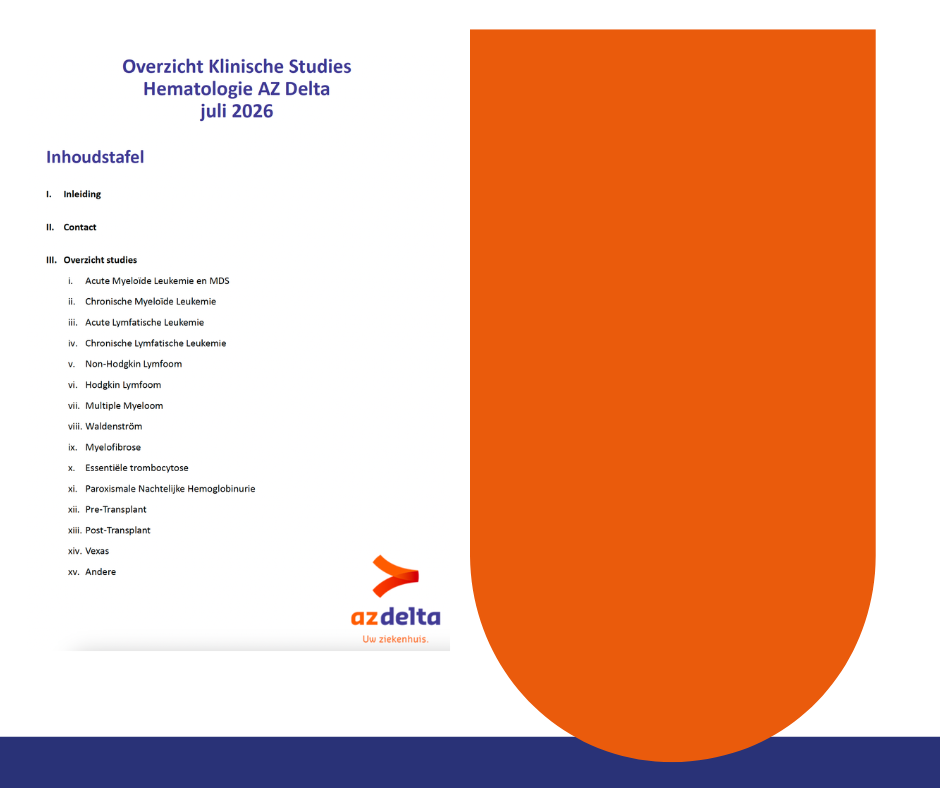
For a comprehensive and clear overview of clinical trials in the field of “Haematology”, click on the image opposite.

Share your experience and improve care!
Living with a chronic illness or long-term health problems brings a lot of
presents challenges.
One of the most important aspects of healthcare is taking
decisions about treatments. But how does that work in practice? To what extent do you, as a
Do patients have a say in these choices? And how do you experience working with healthcare providers?
To investigate these questions, KU Leuven has launched a study with the aim of mapping out
explain how decisions about treatments are made in Belgium and how patients,
doctors and nurses are involved in this.
Your opinion is essential to creating a better
to gain an understanding of what is going well and where improvements can be made.
By participating in this survey, you are helping to improve healthcare and the
patient involvement in decisions about their treatment.
What does it entail?
• A short online questionnaire (± 10-15 minutes)
• Your answers will remain completely anonymous.
• You contribute to better patient care
• The survey is available in Dutch, French, and English.
Please complete the questionnaire. To do so, copy the link below and paste it into your browser:
https://survey.kuleuven.cloud/811482?lang=nl